
Lakeville Resident Lookup Record Scope
A focused Lakeville record check works best when the record type matches the question. Dakota County property information can show a tax owner, mailing address, situs address, legal description, value and tax fields. It does not identify every person at the site. MNVotes is a person-specific registration check. MCRO is a court-party and docket index. Vital records establish events and family facts under separate eligibility rules. Historical directories can place a subscriber or household at a date. Keep each role distinct before drawing a conclusion.
| Record | What It Can Confirm | Lakeville Route | Access Boundary |
|---|---|---|---|
| County tax parcel | Tax owner, mailing address, situs and parcel facts | Dakota County Property Information | Free map; it is not an occupant list. |
| Voter registration | A matching registration and status direction | MNVotes name, date-of-birth and address search | Individual match only; voter-list use is restricted. |
| Court docket | Party role, case number, category and procedural events | MCRO with Dakota County selected | Remote display varies by record type and status. |
| Vital record | Birth, death, marriage or divorce event facts | MDH, issuing county, or district court | Custodian, eligibility and certificate type control access. |
| Historical directory | Earlier subscriber, phone or address connection | MNHS and Dakota County Historical Society collections | Coverage depends on year and publisher. |
Start with the narrowest official source. A name plus a date may suit MCRO, while an old street and approximate period may fit the parcel record or a historical collection. The strongest Lakeville result has two independent points of support, not two copies of the same data.
Lakeville Resident Record Roles
Lakeville records often contain names, but the names mean different things. A parcel record may show a taxpayer, owner or mailing recipient. A deed index names grantors and grantees. A directory identifies a subscriber in its publication year. A court result identifies a party to a case. None of those labels automatically proves present residence. This role-by-role check is especially useful when a Lakeville address uses a Rosemount or Farmington mailing city.
Use the county property map by street address or Parcel ID, then save the situs address, legal description and tax-account fields. If a recorded interest matters, compare the legal description with the recorded instrument in RecordEASE. Its online abstract index reaches back to July 8, 1993; older materials need the recorder office, deed books or microfilm. The parcel and deed records establish land interests, not a complete household roster.
Check Lakeville Court Results
Lakeville cases are heard in Dakota County within Minnesota's First Judicial District. MCRO has Case Search, Document Search, Hearing Search and Judgment Search tabs. In a person-name search, select Dakota County when that is the useful local filter, then record the spelling, search date and filters. The interface supports exact or partial name methods, a trailing wildcard after two characters, sounds-like searching, date-of-birth or filing-date ranges, category, status and court-location filters.
The Minnesota Court Records Online search shows the field layout used for a Lakeville court-record check.
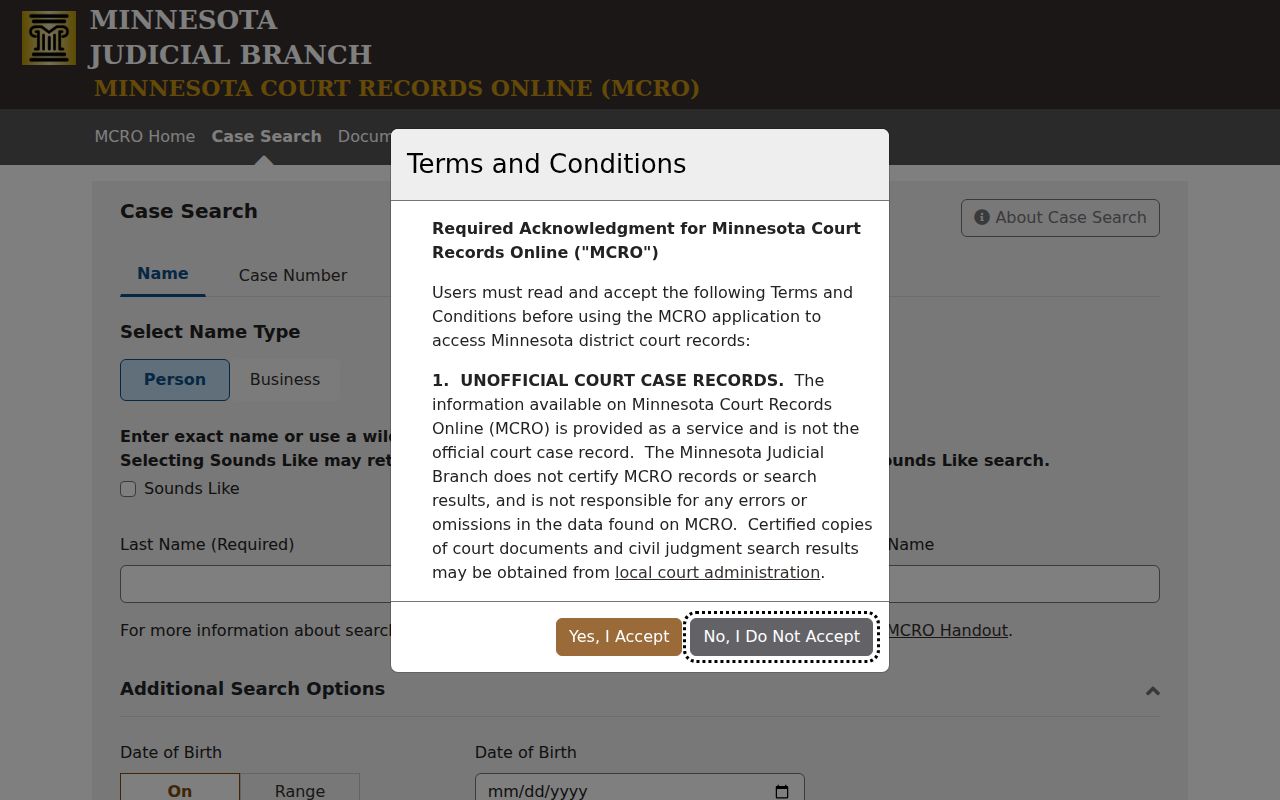
A result can show the exact party and role, case number, category, filing date, status, location, Register of Actions events, hearings, document index and judgment information. A docket event is not a disposition. Remote documents are broadest after July 1, 2015, while sealed, confidential, juvenile, family and some criminal records have tighter rules. Courthouse public terminals can provide a fuller view than remote access.
A sample result inventory should preserve only the fields needed to distinguish one public case from another.
- Exact party name and role
- Case number, category and Dakota County location
- Filing date and current status or disposition label
- Register of Actions event dates and event text
- Hearing date and judicial-officer detail, if displayed
- Document-index entry and whether a public document is available
| MCRO field | Use in a careful match |
|---|---|
| Last, first and middle name | Test exact spelling, initials and known variants. |
| Date of birth | Narrow a name match when it is lawfully known. |
| Case category and status | Separate civil, criminal, family, probate and mental-health records. |
| Court location | Select Dakota County instead of relying on a statewide name hit. |
| Register of Actions | Read dated procedural events rather than assuming their outcome. |
Verify a Lakeville Resident Match
Use a two-source stop rule for a personal Lakeville record check. First identify what the source actually says. Then look for a separate record that agrees on a meaningful detail such as date, address period, legal description, spouse or parent connection, or court location. Similar names are common, and a blank online result may reflect a spelling difference, a processing delay, a date limit or restricted access rather than proof that no record exists.
- Write down the known name, old address or approximate year, and keep the search purpose narrow.
- Use the county parcel map to anchor a known site to its legal description and tax-account role, or use MNVotes for a qualifying individual registration check.
- Search MCRO with the name variants and Dakota County filter. Compare party role, dates and case location, not a surname alone.
- Consult the appropriate vital or historical index for the event or date that matters. Request a custodian copy only when the record type and access rules support it.
- Stop after the evidence answers the question. Do not expand a single-person check into a bulk list of people.
- Docket
- A court case's dated procedural record, including filings, hearings and events. It is not itself a statement that every event ended in a judgment.
- Index and image
- An index lists searchable record details. An image is the underlying document, which may be unavailable remotely or require a custodian request.
- Certified copy
- A custodian-issued copy with official certification. In Minnesota court materials, a certified copy is listed at $14.
Lakeville Resident Voter Timing
MNVotes is useful for checking one person's registration against an address. It requires first name, last name and full date of birth. Its address step can use ZIP mode or county mode, then requires city or township, house number and street. A unit becomes required only when the apartment or unit option is selected. The system updates nightly, and a new or changed registration can take up to 14 days to appear.
Minnesota Statutes section 201.091 treats public voter information differently from the live lookup. Authorized lists may include name, address, year of birth, voting history and district fields, but not full date of birth or Social Security number. The state requires identification and a written lawful-use statement for a copy, prohibits searchable online publication, and provides separate safety protections for qualifying voters.
Lakeville Resident Vital Routes
Vital records answer event questions, not current-address questions. Minnesota Department of Health holds births from 1900 and deaths from 1908 forward. Earlier events are sought from the county of occurrence. Marriage certificates belong with the county that issued the license, and divorce decrees remain with the district court. A birth verification can confirm that a record exists and report limited event facts, but it is not a certified record and does not establish present residence.
The MDH vital-records application information explains the available birth and death request routes for a Lakeville records check.
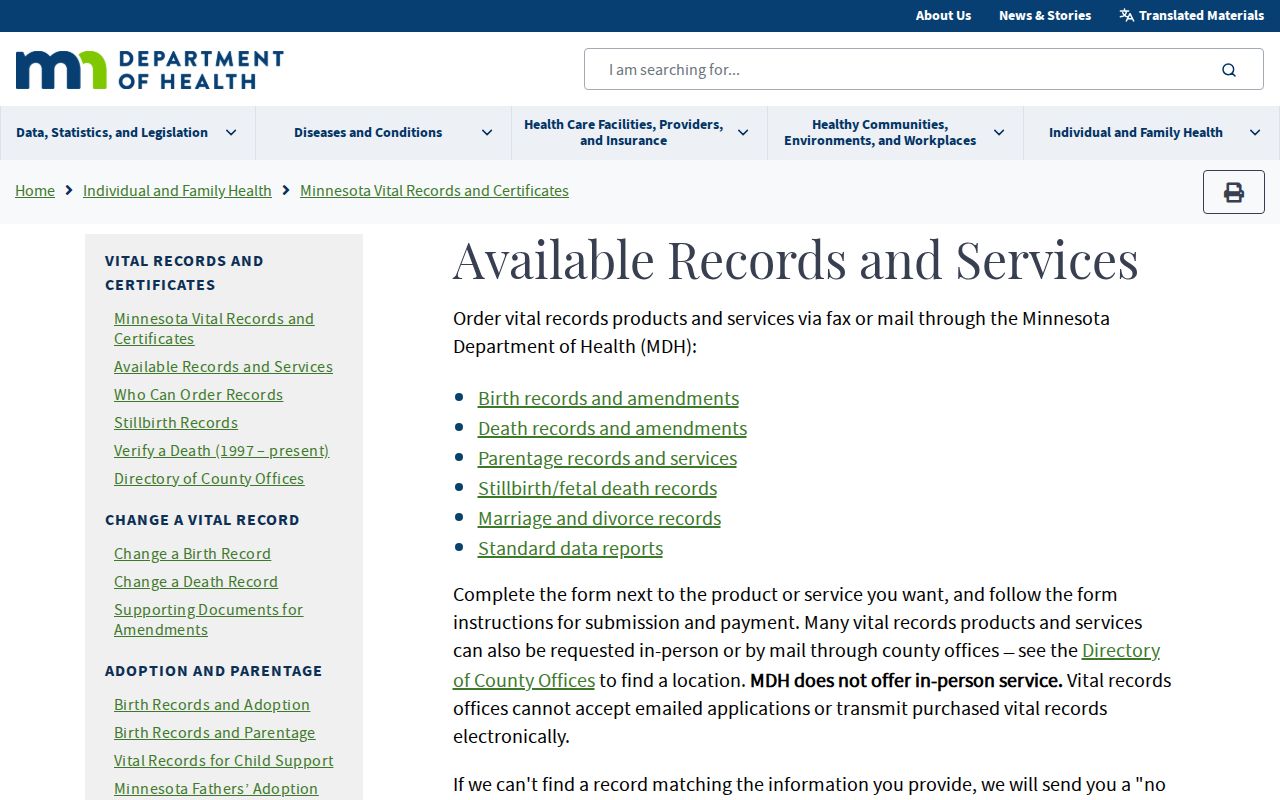
Certified birth access depends on the applicant's relationship or tangible-interest basis and the record's confidentiality status. Unmarried-parent birth records have special confidentiality treatment unless made public, while the 100-year rule in Minnesota Statutes section 144.225 governs their later public status. Mail and fax applications use the applicable identity and notarization rules; MDH does not take ordinary email or in-person requests, though county offices may handle qualifying transactions in person.
Lakeville Resident Historical Checks
When the question concerns an earlier Lakeville resident, keep the year attached to every result. Minnesota Historical Society and Dakota County Historical Society materials can supply telephone-directory, church, cemetery, obituary and household leads. The MNHS finding aid includes Lakeville volumes for 1931 and 1954, a substantial 1960s through 1990s print and microfiche run, and later volumes or sections through 2011. Historic directories may use initials, a spouse or head-of-household convention, an older mailing name, or a telephone exchange. They help reconstruct an earlier connection but do not confirm a current person or address.
For a probate or family question, a public case can establish a procedural link, yet it may also contain protected parties or sensitive addresses. For an adoption question, MDH has a separate process for eligible Minnesota-born adopted adults and a private Father’s Adoption Registry route. Those specialized rules are not gaps to work around. They identify the correct custodian and the point where ordinary name searching must stop.
Lakeville Resident Custodian Requests
An online index ending does not mean the record never existed. Dakota County's recorder holds older deed material through office research, deed books and microfilm. Court counters can explain the route for paper or off-site files. City and county records may also be requested under the Minnesota Government Data Practices Act, Minnesota Statutes chapter 13, subject to classification and redaction. Ask for the precise record, date range and known number, then keep the response with the original search notes.
Correct a factual error at the office that maintains the record. Identify the record number or date, provide the supporting detail and request a written explanation if a correction is declined. That preserves the distinction between an official source, an interpretation, and a historical lead.
Lakeville Resident Lookup Safety Limits
Minnesota public-data access has real boundaries. Safe at Home provides address-confidentiality handling for qualifying people who fear for their own, a child's, or a household member's safety. Court results can omit sealed, confidential, juvenile or other restricted material. Parcel mailing addresses can belong to a trust, business or another household. Do not try to identify a protected address or treat a missing result as an invitation to search more aggressively.
Lawful personal use. A focused Lakeville records check is appropriate for a personal question, family history, or reconnecting. Do not use information to stalk, harass, intimidate, monitor, or harm another person; Minnesota law provides civil and criminal protections against harassment and stalking.