
Finding Lakeville Residents by Record
Lakeville does not maintain one public list of everyone in town. Instead, a search follows the fact you need to verify. A current street address points first to Dakota County parcel information. A full name and date of birth can support a narrow voter-registration check. A past address may be better served by a telephone directory, census record, or deed. Court, vital, and city files answer different questions again. Keeping the record role beside the result avoids turning a tax owner, historical subscriber, or case party into a claim about present residence.
Start with one address, one name, or one year. Record the source, the date checked, and the field that matched. A parcel’s situs address is where land sits. Its tax mailing address may point elsewhere. An old directory gives a period listing, not a live contact. When a first result looks promising, match it against a second independent record instead of expanding into a broad household search.
- Use a Lakeville street address in the county property tool and save the parcel number, legal description, and returned tax-owner role.
- For one person, use the state registration lookup only with the required identifying information, then note whether it confirms a match or offers next steps.
- Search a recorded document when the question is ownership history, not present occupancy. The recorded parties and legal description create the title trail.
- For an earlier household, check the local historical collections, telephone-directory years, census material, and obituary indexes.
- When the needed government record is not online, ask the named custodian for the specific record, date range, address, or case number.
Note: A careful Lakeville residents directory search stops once the relevant record answers the question and does not turn narrow evidence into a people list.
Lakeville Offices for Resident Records
Lakeville sits in Dakota County, but county administration is not all in Lakeville. The recorder and Property Taxation & Records function work from Hastings, while county GIS also offers public service and terminals through its network. City departments hold permits, planning material, utilities, and other municipal records. The Minnesota Secretary of State controls the statewide voter tools, and the district court system controls court material. Choosing the office by record type is faster than treating City Hall as a catchall custodian.
Dakota County Property Taxation & Records
1590 Highway 55
Hastings, MN 55033
651-438-4597 research
Dakota County Property Information
Address or Parcel ID search
Online county property tool
952-891-7081 GIS maps
Minnesota Election Information
Registration and address match
Statewide official service
651-438-4305 county elections
The By Street page keeps the address-to-parcel route in one place. City records that are not indexed online can be requested through the municipal data-practices channel, while old material may lead to a historical collection rather than an office counter.
Lakeville Parcel Records by Address
The free Dakota County property interface accepts an address or Parcel ID. A returned parcel can show the site address, municipality, legal description, owner or taxpayer mailing address, assessed values, tax information, building facts, school district, watershed district, and status fields. This is strong evidence about a tax parcel. It is not a complete Lakeville resident roll. A mailing address can belong to an individual, a trust, an entity, or a different address, and a parcel can hold more than one unit.
| County field | How it helps | Limit to retain |
|---|---|---|
| Address or Parcel ID | Finds the county’s property record | It is a parcel key, not a person search |
| Situs and municipality | Locates the land in Lakeville | Does not establish who occupies it |
| Owner and mailing address | Identifies the tax-account role | May differ from the situs address |
| Legal description | Connects the parcel to plats and deeds | Needs comparison with the recorded instrument |
- Parcel
- A tax and map unit with a county identifier and geometry.
- Situs address
- The physical address the county assigns to the parcel.
- Index
- A finding tool that points to a record; it is not always the document itself.
- Criss-cross directory
- A historical directory organized from an address toward a subscriber, when that volume includes one.
Lakeville Voter Lookup Boundaries
Minnesota Voter Information is a narrow matching tool. It asks for first name, last name, and date of birth, then uses an address path through either ZIP or county mode. The result can confirm a registration match or provide official next steps. It is updated nightly, while a new or changed registration can take up to 14 days to appear. A no-match can reflect timing, spelling, address history, or another matching issue.
| Field or mode | Purpose | Lakeville use |
|---|---|---|
| First and last name | Identifies the registration inquiry | Use exact spelling and no suffixes |
| Date of birth | Narrows one-person matching | Required for the public lookup |
| ZIP or county mode | Sets the address route | Choose the mode that matches the address |
| House number and street | Completes address matching | Unit information is conditional where applicable |
State law permits defined voter-list fields and authorized copies, but it restricts use and bars online searchable publication. A street-sorted walking list is obtained through the state request process with lawful-use certification, not by repeating public lookup searches. Lakeville residents who need an address-safety route can use voter withholding or the Safe at Home program.
Current Lakeville Resident Record Roles
Several current sources can look directory-like, yet each identifies a different relationship. The county property map is best for the tax parcel and owner role. The recorder connects named parties to a recorded interest. The voter tool checks one registration match. MCRO identifies a case party and court event, not a street address. Keeping these roles distinct is a useful Lakeville safeguard, especially when the same name appears in more than one record system.
| Lakeville source | Record role | Custodian | Access route |
|---|---|---|---|
| Property Information | Tax owner, mailing address, parcel facts | Dakota County | Free address or Parcel ID search |
| RecordEASE | Grantor, grantee, instrument party | County recorder | Account and session or subscriber access |
| Minnesota Voter Information | One registration match | Secretary of State | Name, date of birth, and address inputs |
| MCRO | Case party and docket events | Minnesota courts | Remote search or fuller courthouse access |
| Lakeville staff directory | City office contact | City of Lakeville | Department and name search |
A commercial people-finder category may merge stale data and same-name people. Official sources provide narrower answers but give the custodian, date, and record role needed to test a result. For a focused one-person sequence, the Resident Lookup page pairs the most useful official routes.
Lakeville Data-Practices Requests
Lakeville’s Data Practices page is the city intake point for records held by municipal departments. The catalog includes building and inspection files, code-violation material, plans, engineering as-builts, stormwater, environmental complaints, fire records, licensing, and utility records. The city directs requests to JustFOIA. A defined request should name the department, record type, address or project number, date range, desired format, and whether inspection or copies are wanted. Availability and redactions still depend on the classification of the particular record.
Under the Minnesota Government Data Practices Act, public government data may be inspected at a reasonable time and place, generally without an inspection fee. Copying, certification, staff work, and special electronic production can have permitted costs. The law does not turn a private record into government data, and a request should ask the custodian to identify the legal classification if information is withheld.
See the Lakeville Data Practices and Data Requests page before filing. The linked request system is shown in the official city source below.
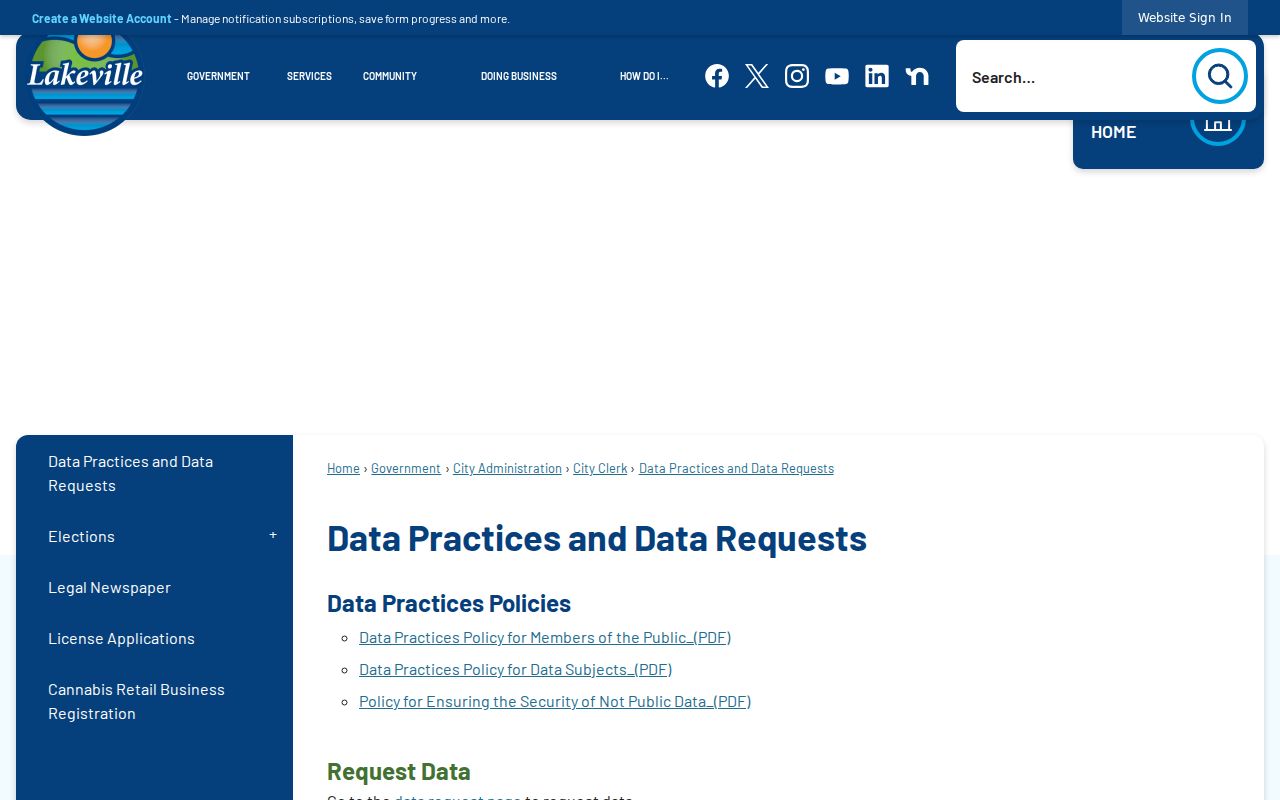
City-held records can document an address or project event, but an applicant or project contact is not automatically a Lakeville resident.
Lakeville Vital Record Routes
Vital records answer event and family-history questions, not current-address questions. The Minnesota Department of Health holds births from 1900 forward and deaths from 1908 forward, while earlier events lead to the county of occurrence. Marriage certificates come from the county that issued the license. Divorce decrees come from the district court that granted them. A birth record can have tangible-interest and confidentiality limits, including special treatment for unmarried-parent birth records. A noncertified birth verification has a smaller scope than a certified certificate.
The state’s available-records guidance distinguishes the custodian, product, and eligibility path. That distinction protects family records from being treated as a general Lakeville residents directory. For an older local event, county, church, cemetery, newspaper, and historical-society material may be the better starting point.
The Minnesota Department of Health available-records page explains the state route and its eligibility information.
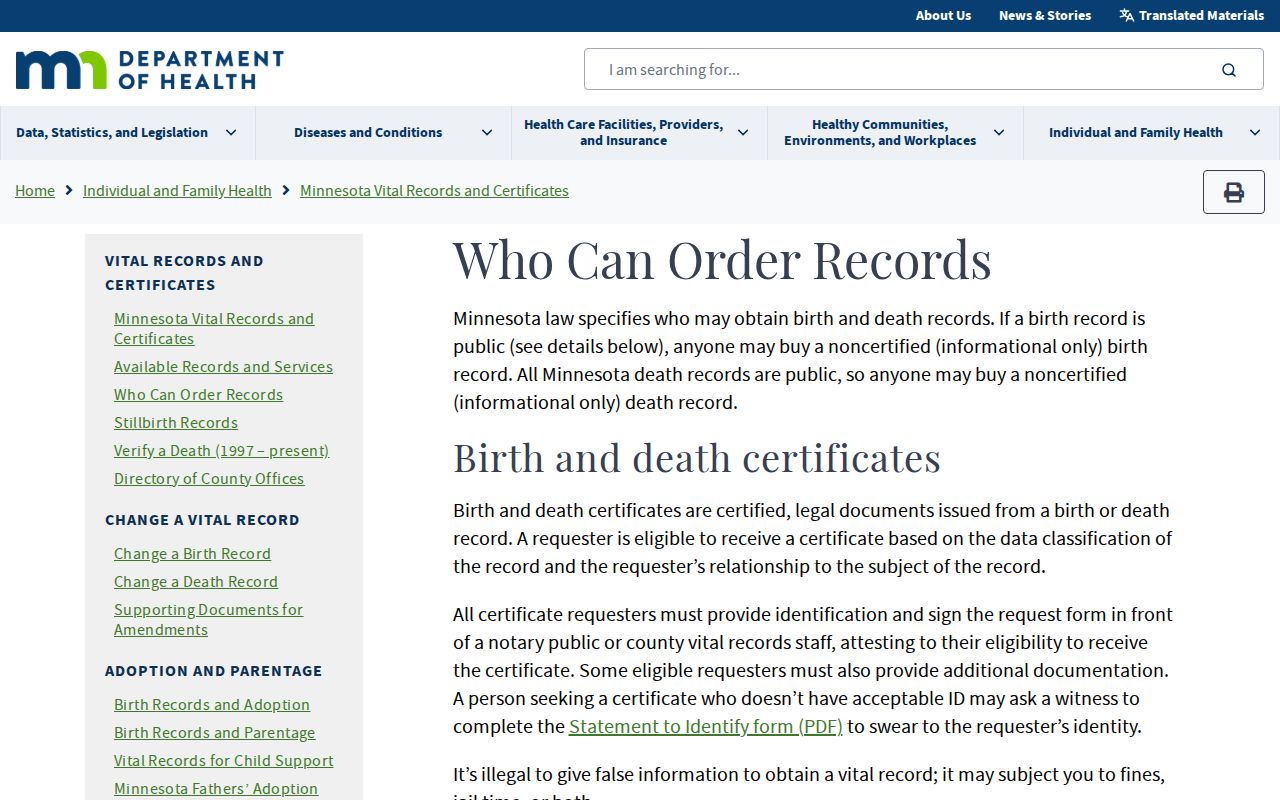
Confirm the event type and custodian before paying for a certificate, verification, or court copy.
Note: A historical birth, death, or marriage record can support a date or relationship, but it does not confirm a present Lakeville address.
Lakeville Address Safety Protections
Some missing results are protections, not gaps to overcome. Minnesota Safe at Home provides qualifying residents with a designated address, mail forwarding, and protected-address handling. Voters can also seek withholding for personal-safety reasons. Court files can be sealed, confidential, juvenile, or otherwise restricted. A county tax account, voter entry, historical phone listing, or court result should never be used to infer a protected address.
The Safe at Home program describes the qualifying safety route and its designated-address process.
Address confidentiality is a reason to stop a search, not a reason to pursue extra sources.
Lakeville Property Watch and Copies
Dakota County’s Property Watch is a free alert service for future recorded documents. It monitors a selected person, entity, or legal-description entry after enrollment and sends an alert with the matched party, recording date, document number, and document type. It is not a title search, does not reach backward before signup, and common names can generate extra alerts. That makes it a useful Lakeville research tool for a bounded title question, not a directory of people.
Dakota County also warns about high-priced deed-copy mail offers. County instructions list deed copies at $1 per page or $10 for a certified copy, with office and mail routes for a specific document. The safest response to a payment demand is to begin at the county’s official recorder pages, not the phone number or link in an unexpected offer.
Open the Dakota County Property Watch form for the official program and its current notices.
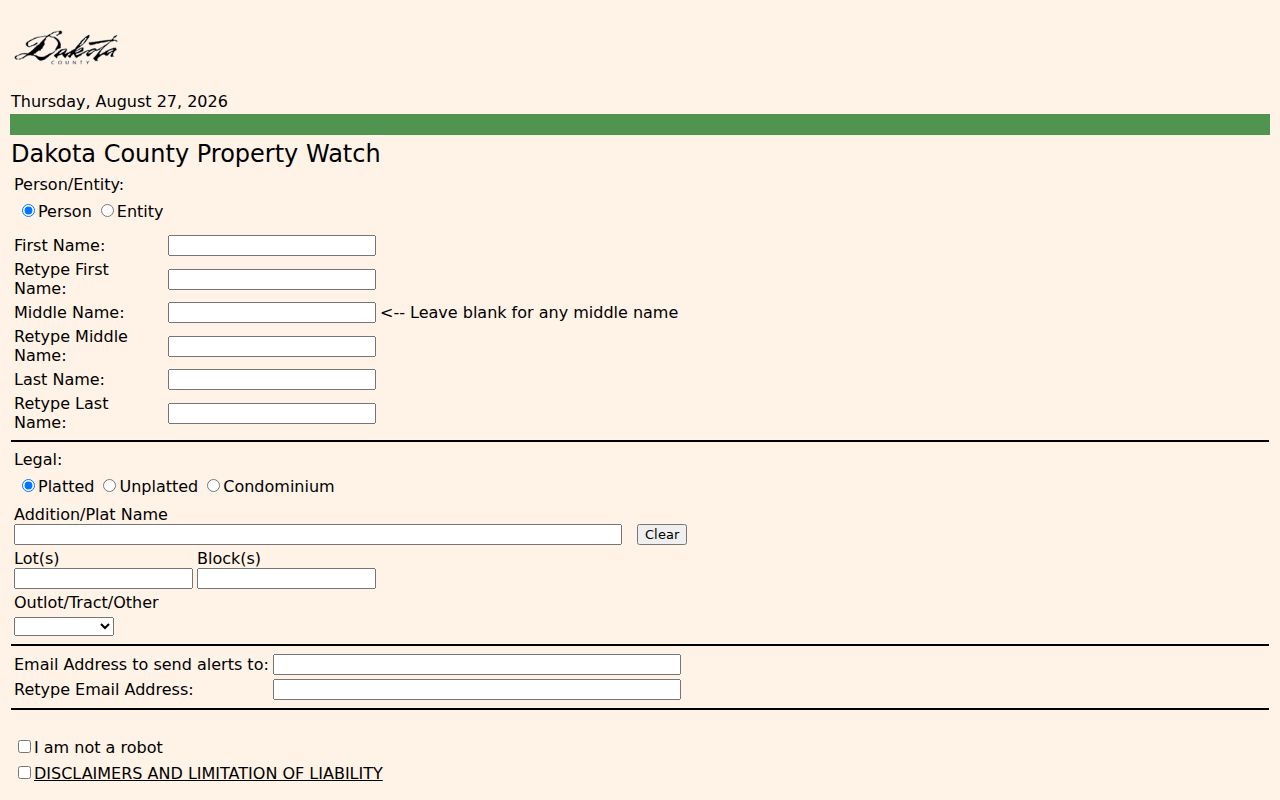
The image shows the county’s future-alert route, which should be kept separate from historical ownership research.
Historical Lakeville Resident Directories
Lakeville’s strongest continuous historical directory lead is the Minnesota Historical Society telephone-directory finding aid. It identifies Lakeville holdings beginning with a 1931 print volume, then 1954, annual or near-annual material across much of the 1960s through 1990s, and later volumes or sections through at least 2011. The collection includes print and microfiche. A volume can supply a subscriber name, telephone number, address or exchange context for its date, while a missing listing can reflect unlisted service, head-of-household conventions, a move, or a coverage gap.
Dakota County Historical Society adds census, church, cemetery, obituary, marriage-announcement, newspaper, and local-history leads. The digitized 1945 Central Telephone Directory is a period artifact, but the research did not establish a legible individual Lakeville entry to quote. Use its date and directory structure, not an invented transcription. The full collection method appears under City Directories.
Note: A directory entry documents a subscriber or listed household for a particular edition, not every person at an address.
Lakeville ZIP and Planning Geography
Lakeville addresses can carry more than one geographic label. The city identifies 55044 for core Lakeville delivery, while addresses north of Dodd Boulevard and east of Cedar Avenue can use Rosemount 55068, and addresses south of Dodd and east of Cedar can use Farmington 55024. The mailing city can therefore differ from the municipal identity. USPS returns a delivery standard, not proof of who receives mail at the address or whether the property falls inside a city boundary.
County parcel, watershed, school-district, map, and city planning records add other layers. Lakeville’s seven planning districts use physical barriers, land use, lakes, wetlands, and infrastructure context. Those are useful ways to understand a place, but no planning district is a neighborhood-membership list. Compare the full address through USPS and the county parcel system before carrying it into an old map or directory.
Lakeville’s Layered Record History
Lakeville’s local history starts with 1853 settlement and the road associated with Captain William B. Dodd, while Dakota County was established in 1849. That history explains why an old Lakeville name can appear in township, county, church, plat, census, and city sources rather than one municipal file. County maps retain historic series for 1916–71, 1972–86, 1987–2004, and 2007–25. The recorder’s online abstract index begins July 8, 1993, with older deed books and microfilm still part of the research route.
The practical thread is date plus source type: a current parcel identifies the land, a recorded deed traces legal interest, a historic map checks streets or plats, and a directory or census tests a period household. The systems overlap, but they are not interchangeable. Lakeville research is strongest when each fact keeps the date and custodian that gave it meaning.